Roast or Brew? Escaping the Coffee Death Spiral
When the cup is off and you are both the roaster and the brewer, every fix you try muddies the next one. Matt Perger called it the downward spiral of death. Here is how we triage roast versus brew, and why writing it down is the way out.
You roast a coffee, rest it, brew it, and it's sour. So you brew it hotter. Now it's harsh. You roast the next batch darker. Now it tastes of roast and the fruit is gone. Three changes in, you no longer know what caused what.
Matt Perger named this years ago in The Downward Spiral of Death. His version is about cafés. A barista judges espresso by taste alone, so shots get shorter to add "body". The roaster sees sourness and roasts darker, and the shots get shorter again to hide the ash. Roast and brew keep compensating for each other and the coffee drifts for months. His fix is to measure extraction, so you know which side the fault is on. He calls the result the Upward Spiral of Happiness.
As a home roaster you are the barista and the roaster at the same time, so the whole loop runs inside one person. Here is how we get out of it faster.
Step one: roast fault or brew fault?
A Kaffelogic owner we've been trading emails with, a dozen years into home roasting, passed on a rule from a professional roaster. It is the most useful thing in this post:
Before you change anything, decide whether you are tasting a roast defect or a brewing problem. If there's no roast defect (nothing grassy, bready, hollow or ashy), then sour usually means under-extracted and bitter usually means over-extracted.
Fix that kind of cup at the brew bar, not in the roaster. A brew change costs a few grams of coffee. A roast change costs a batch and a week of rest. Tap how your cup tasted:
Brew fix compass
Tap how it tastedUnder-extracted
Water pulled the sharp acids but not enough sugars.
Change one thing, then brew again.
Grind
Do firstGrind finer
Water temp
OrHotter
Water amount
Hold
Pour and swirl
OrLonger bloom, one swirl
The details are in why coffee tastes sour and why coffee tastes bitter.
Step two: change one thing, then taste
The death spiral feeds on changing two things at once. Change the grind and the temperature together and you can't tell which one helped. Change the roast level and brew the new batch differently and you've learned nothing about the roast.
So run one change, on the same roast, at the same rest day, and keep everything else fixed. If the brew fix moves the cup, you're done. If it doesn't, the roast is now the real suspect, and you can change the roast knowing the brew isn't hiding anything.
Here is what that looked like for us this week, on a Colombian Pacamara that kept tasting sour as it cooled. Two roasts on the same profile were both logged sour. The roast log showed a development time ratio of about 11% on both, at the bottom of what that profile usually gives. Both cups were also brewed with boiling water.
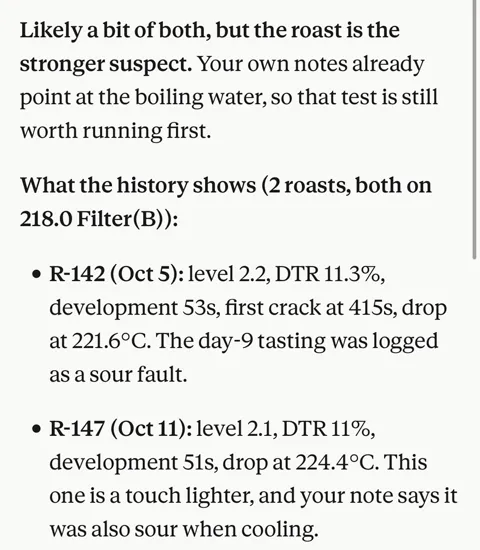
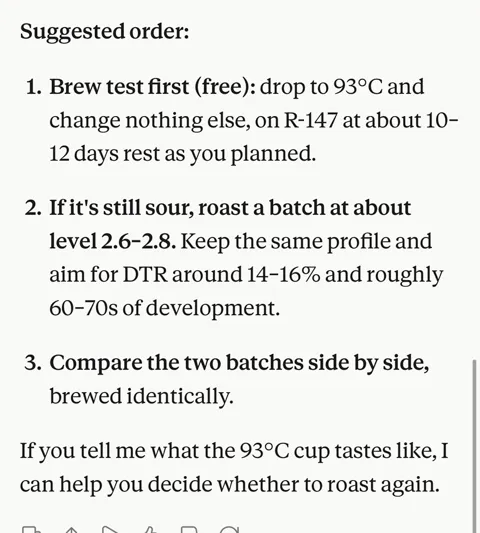
Both suspects were plausible. The order that keeps the spiral short is the free test first: the same roast, the water at 93 °C instead of boiling, nothing else changed. Only if that's still sour do we roast a batch a step darker on the same profile and compare the two brewed identically.
Step three: don't forget the rest
Rest is the third suspect, and it's easy to blame the roast for it. Many naturals and anaerobics taste closed and flat in their first week: subtle fruit, a little dry, sour as the cup cools. That is exactly the cup we described for an Indonesian natural anaerobic early in its rest.
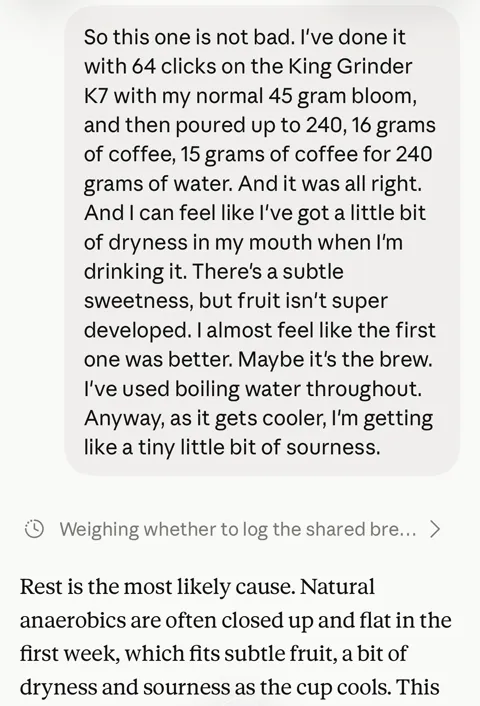
How you store the beans matters too. We used to rest roasts in a sealed glass jar and open it for the first time at day 10. A lot of pressure came out, and the cup was poor; by day 17 the same roast was good. Now we lift the lid every couple of days, and that roast tastes good from day 10.
Rest also depends on how you brew, so rules like "always rest for two weeks" (or "aim for 20% DTR") turn into hubris once you stop asking why. Rested coffee makes conventional espresso predictable. A lever machine or an immersion brewer can work well right off the roaster if you adapt the grind, the temperature and the agitation to the coffee.
The hump
One more trap. When you dial in a brew step by step, the cup can get worse just before it breaks through. Some compound comes forward, the cup turns harsh, and it's tempting to decide the roast is broken or the bean will never dial in. Often the answer is one more step down the same path. If a single change made things worse but the direction still makes sense, take one more step before you turn around.
What decides most of it anyway
- Greens. The best predictor of a delicious roast is the quality of the green coffee. Buy a small bag first and only reorder what responds well to your roaster.
- Defaults. Over about 130 roasts we've used stock profiles (NCT Filter B and E for light roasts) and changed only the roast level. That keeps one whole variable out of the spiral while you learn.
- Small batches. On a 100 g air roaster you drink your mistakes, but only for a few days. That's one more reason to change one thing per batch.
Writing it down is the way out
Perger's way out is measuring. Most home roasters will never own a refractometer, but the real lesson is the same: stop compensating blind, and keep a record of what you changed and what the cup did. That's the part nobody keeps up. Notes on paper get lost or can't be read a week later, and nobody types up a cupping at the brew bar.
Our version is talking. We connected the BrewedLate roast log to the Claude app on a phone, and after a cup we just say how it tasted and how we brewed it. The agent reads the roast logs, the rest days and the earlier brews, sorts roast from brew from rest, logs the cupping, and next time answers "how did I brew this last time, and what did I want to change?" The screenshots above are from those conversations. It runs the same triage as this post: roast or brew, one change at a time, rest as the third suspect.
Is it the roast or the brew? Ask your roast log
Let's have a look at the roast history of the Colombian pacamara. I've been tasting it, and it's good. There's some fruit, there's some sweetness, but I'm still getting some sourness when it cools, and I'm wondering if this could be roast related or if this is something that is related to brewing.
Likely a bit of both, but the roast is the stronger suspect. Your own notes already point at the boiling water, so that test is still worth running first.
What the history shows (2 roasts, both on 218.0 Filter(B)):
- R-142 (Oct 5): level 2.2, DTR 11.3%, development 53s, first crack at 415s, drop at 221.6°C. The day-9 tasting was logged as a sour fault.
- R-147 (Oct 11): level 2.1, DTR 11%, development 51s, drop at 224.4°C. This one is a touch lighter, and your note says it was also sour when cooling.
Why I lean roast:
- An 11% DTR is the very bottom of this profile's 11–23% range.
- A level of 2.1–2.2 is lighter than the medium you set as your goal for this bean.
- Your goal notes already warn that under-roasting leaves anaerobic ferments tasting sharp.
- Sourness that gets clearer as the cup cools is typical of underdeveloped coffee. It's also typical of lactic and acetic acids from a 130-hour ferment.
Why it might not be only the roast:
- The same profile at level 2.2 has worked well on your SL28 from the same farm, including an 87-point cup. So the profile itself is fine.
- You're brewing with boiling water, and the "sour-bitter edge" you describe sounds like a harsh extraction. Going from 100°C to 93°C often cleans that up on a delicate natural.
Suggested order:
- Brew test first (free): drop to 93°C and change nothing else, on R-147 at about 10–12 days rest as you planned.
- If it's still sour, roast a batch at about level 2.6–2.8. Keep the same profile and aim for DTR around 14–16% and roughly 60–70s of development.
- Compare the two batches side by side, brewed identically.
If you tell me what the 93°C cup tastes like, I can help you decide whether to roast again.
Okay, let's plan a roast for these parameters so I can try that next.
Suggested roast
218.0 Filter(B) · level 2.6 · 100 g
Saved
I've planned roast R-151 for the Pacamara.
- Profile: 218.0 Filter(B), the same as R-142 and R-147.
- Roast level: 2.6, up from 2.1–2.2. This is the only change, so any difference in the cup comes from roast level.
- Batch: 100 g green, which leaves 700 g afterwards. Stock isn't deducted until you actually roast it.
- Targets: DTR of about 14–16% and 60–70 s of development. Check these against the klog afterwards.
- Brew: V60, K7 at 64 clicks, 16 g to 240 g, with water at 93°C. Taste at 10–12 days rest.
The plan combines a roast change and a cooler brew. If the sourness goes away, you won't know which one fixed it. To separate them, brew R-147 at 93°C first. You'll then know whether the roast change was needed at all.
Recorded in Claude iOS, 15 Oct 2026.
Talk to your roast log
Log roasts and cuppings for free. With Pro, connect your own AI agent and record a cupping by voice from your phone, then ask what to change next.
Frequently Asked Questions
What is the coffee death spiral?
How do I know if a sour cup is the roast or the brew?
Should I change the roast or the brew first?
Can resting coffee cause a sour or flat cup?
Related Articles
Home Coffee Roasting Hub: A Complete Beginner to Advanced Guide
Master home coffee roasting with our complete hub. Learn equipment selection, green bean sourcing, roast profiles, first crack, software, and logging.
How Long Do Green Coffee Beans Last? Storage Guide for Home Roasters
Green coffee keeps its quality for 6 to 12 months in a sealed bag in a cool, dark cupboard, and longer in hermetic liners or the freezer. Here is how to store it, how to tell it is ageing, and how to buy so you never roast a stale bag.
NCT vs F-Series: Kaffelogic Profiles Compared by the Numbers
We measured all 8 F-Series and 24 NCT profile curves and compared them against 58 logged roasts. NCT profiles heat faster and call first crack about 10 °C higher, but they are not always the shorter roast.
Development Time Ratio on a Kaffelogic: 75 Roasts of Data
We checked the usual DTR rules against 75 logged Kaffelogic roasts. 86% of the variation in DTR came from which profile was loaded, and our best cups landed anywhere from 10% to 24%.